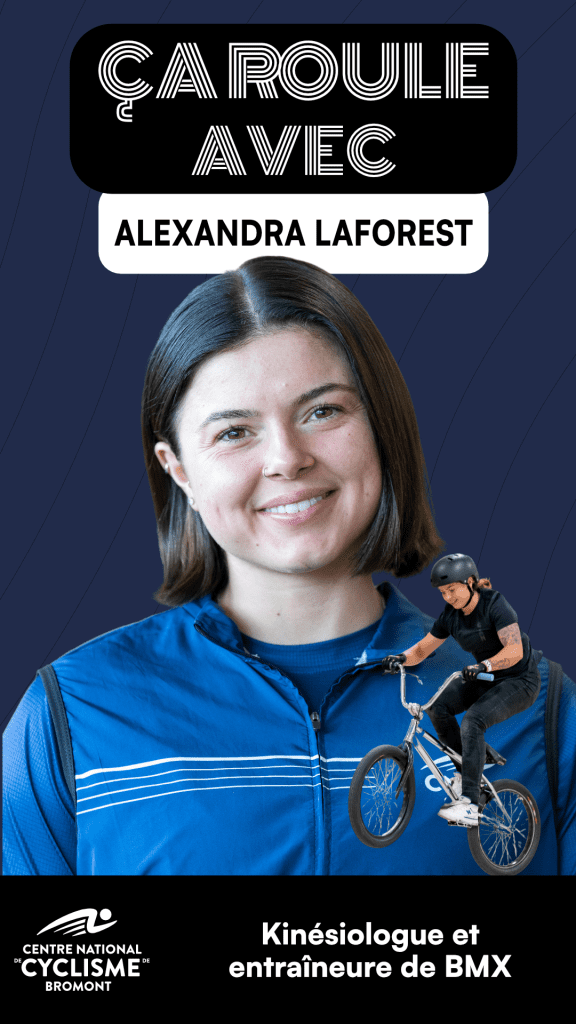
Originally from Boisbriand, Alexandra Laforest is a kinesiologist and BMX coach at the National Cycling Centre in Bromont. She plays a key role in the athletes’ physical preparation while contributing to the development of the CNCB BMX Club. Throughout her career, Alexandra has embodied an accessible and motivating approach to sports, where pushing one’s limits, consistency, and the joy of movement take center stage. In this interview, she reflects on her journey, shares her vision of training, and explains why staying active—regardless of one’s skill level—is essential.
From Discovery to Passion
1. Can you introduce yourself in a few words?
My name is Alexandra Laforest, and I’m a kinesiologist and BMX coach at the National Cycling Centre in Bromont. Here at the CNCB, my role involves physical training, managing the BMX club, and also working on a few BMX freestyle projects. I’m originally from Boisbriand and moved here for work when the freestyle area opened.
2. Why did you decide to become a coach?
Honestly, I enrolled in college and didn’t really know what kinesiology was. I was heading toward sports medicine and thought to myself, “This will be a stepping stone to boost my grades and get into medical school later.” But eventually, I realized, “It’s fun to coach people, to help them push past their limits.” ” So at first, I was really just doing physical conditioning, and then when I started riding BMX, I came here and took part in the opening of the *freestyle zone*. After that, they told me they were looking for a kinesiologist, and that’s how I became a bike coach.
3. What made you want to work here at the Bromont National Cycling Centre?
It’s really the atmosphere. You come in here and you see kids learning the basics on the pump track, older folks playing pickleball, people on the track, and in the freestyle zone. So it brings together all the cycling communities in one place, and all communities in general. There are also people walking on the track and all that. So, it’s really the atmosphere that made me want to work here.
From Performance to Everyday Well-being
4. Why is physical conditioning important for cyclists or athletes in general?
Yes, there’s performance and all that, but also injury prevention. In all sports, there’s a repetitive movement pattern, so if you don’t do strength training, you’re constantly activating the same muscles. So physical conditioning is about working the whole body, and after that, we’ll focus on performance by optimizing movements within those patterns. If you come to see me for kinesiology, at first, it’ll really be about overall strengthening, stabilizers, and all that, to make sure you’re not compensating in your everyday life, and to age well. Yes, it’s important to perform well in your sport, but for most people, they’re not going to the Olympics. So it’s about being able to move well in your daily life, and then continuing your hobbies and sports for the rest of your life.
5. Physical conditioning for the CNCB BMX Club is a new addition this year at CNCB. Can you tell us about it?
It’s new this year that, for BMX racing, we’ll be incorporating physical conditioning. During the class, we split the group in two, so half the time we do strength training at the gym on Wednesdays. The rest of the time, we do more functional training on the track. As for the younger kids (ages 5 to 10), I don’t have them do weight training—it’s more like play—but through play, they get plyometrics, jumping, balance, and core work. So they don’t realize it, but they’re getting an introduction to strength training through games, and the kids really love it. It also adds a bit of discipline to the whole thing. The fact that we spend half the class doing strength training keeps us more focused, and then for the other half, we’re on the pump track—it adds a bit of seriousness to the workouts.
Every Monday from 10:30 a.m. to 11:30 a.m., we have access to the track at the Bromont National Center. We come to walk for an hour or less—it’s really at your own pace, and there’s no pressure. There’s always a kinesiologist—either me, an intern, or someone else at the center—who’s there to answer your questions. So if you ever have back pain, knee pain, or anything else, we’re here to listen to you, give you exercises, and all that. It’s walking, with on-site kinesiology services, and it’s free—always free!
7. What makes this activity special for the participants?
It’s really the community that’s quietly forming. A lot of people come, and they talk to each other throughout the walk, getting to know one another. Also, it’s the same group that sticks together, especially during the community lunches on Fridays, so it’s often the same volunteers who are together. It’s fun to see how it keeps them active.
Going Beyond Sports
8. What advice would you give to someone who wants to start exercising or get back in shape?
My number one piece of advice is to prioritize consistency over perfection. So choose something you’ll actually do and feel confident you can stick with. For example, if you enjoy walking, start by taking 15-minute walks every other day. Then, as you stick to that goal, you’ll be able to increase your exercise time and add other types of activities. Start with something you enjoy, something “easy,” and then, once the habit is established, you can build on it, and it’ll just become second nature.
9. What do you hope to convey beyond the sport itself?
It’s really about pushing yourself to the limit, and also not being afraid of being bad at something. In the sense that when you start a new sport, you won’t be the best at it right away. I’ve been cycling for about two and a half years now; I’d never done it before, and now I coach BMX. My goal with this is really to show that I’m a girl and that I can start a new, predominantly male sport without being afraid of being worse than the others and giving it 100%. I see it with the BMX race girls, it lights a little spark in them: “Okay, Alexandra hasn’t been doing this for very long, but she’s actually doing well and more importantly, she’s pushing herself, going beyond her limits, and she’s not afraid of being less good than some 15-year-old boy.” When it comes to physical training, it’s about demonstrating healthy lifestyle habits and staying active in all areas, not just weight training, for example.
10. What do you like most about being a trainer?
It’s the variety of my clients—the fact that I get to train athletes, young people, older adults, and both private and group sessions… I really have a great mix. Personally, I’m the kind of person who gets bored if I do the same thing all the time. So having such a diverse clientele keeps me motivated and engaged—it means I’m constantly reflecting on my approach, and that’s what I love most about this job.
Through her career and her involvement with the CNCB, Alexandra Laforest embodies a vision of accessible sports, where pushing one’s limits, consistency, and the joy of movement take center stage. Whether through physical training, BMX, or the initiatives she launches, she helps guide people of all ages toward a more active lifestyle. With her warm and motivating approach, Alexandra reminds us that what matters isn’t being perfect, but simply getting started… and keeping at it.
To watch the interview video, click here!
WATCH THE INTERVIEW