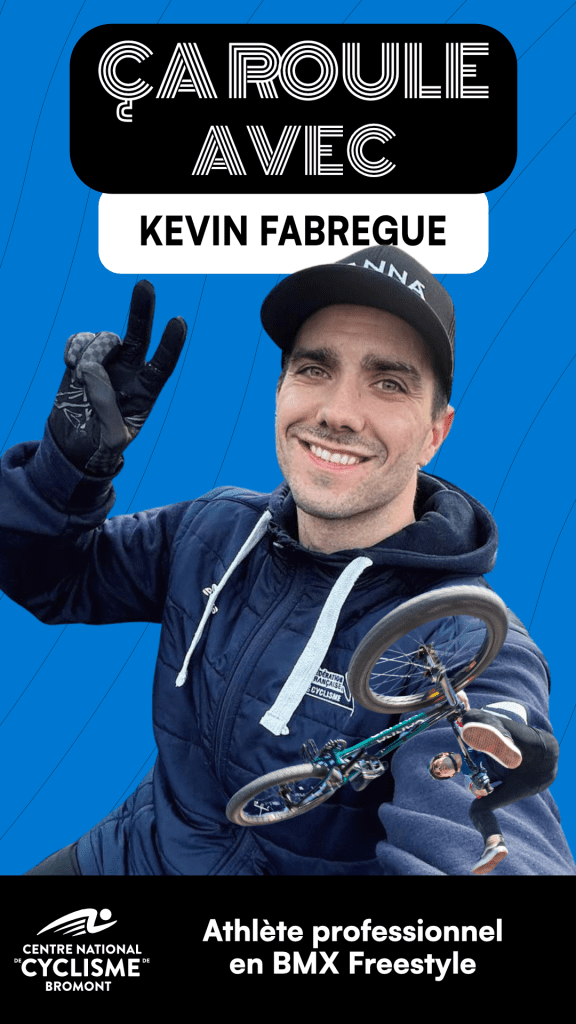
Originally from France and now based in Montreal, Kevin Fabregue is a professional freestyle BMX athlete and ambassador at the Bromont National Cycling Center. A regular at the CNCB to train and share his passion, Kevin is one of those athletes who push the boundaries of their discipline while helping to grow the community.
In this interview, he looks back on his early days in the world of cycling, explains what still motivates him to ride day after day, and shares his vision of a sport where progress, fun, and freedom take center stage.
From Cycling Beginnings to Discovering BMX
1. Can you introduce yourself in a few words: your name, your role at the CNCB, and where you’re from?
Hi, I’m Kevin Fabregue. I’m a professional freestyle BMX athlete. I live in Montreal, I’m from France, and I often ride here at the Bromont National Cycling Centre.
2. How did you get into cycling?
I officially got into cycling when I was 10 or 11, but I started riding bikes at a very young age. I was already riding a bike when I was around 2 or 3. I started with cross-country around age 10 or 11; I competed in provincial races. But after a few years, what interested me most was jumping I was getting a little tired of climbing the mountains; I couldn’t wait to ride down them and get to the section with the bumps. Then I asked my parents for a BMX, but that didn’t happen until much later. It wasn’t until I was about 13 that I got my first BMX and started riding it just for fun.
3. Why did you choose BMX, and what excites you most about the sport?
I chose BMX because it’s a sport where you can challenge yourself every day; there’s always something new to learn—it’s endless. Today, I’ve been riding BMX practically every day for over 15 years, and I’m still far from where I want to be. There are always things in my head that I want to learn, so it’s like there’s no end to it—the progress never stops. Plus, there are so many areas to work on in this sport. It could be going higher, being fluid, doing the same trick but executing it better—that’s really what I love. Also, it’s still an artistic sport; it’s visual, it’s something you do in the air, and that’s something that draws me in.
A journey guided by progress and passion
4. What still motivates you to ride and train day after day?
At first, it was just about learning new tricks and then going out to ride with my friends. I think it was just doing something different that motivated me. Today, I’m 30, so of course my motivation is different. It’s mostly competitions that motivate me to keep training because I have a goal or something I set for myself. So I think competition, right now, is what motivates me the most, but also just showcasing my sport in a positive way, showing it to younger people. I think the older I get, the more I enjoy seeing young people ride and improve, having fun—it gives me the same feeling I had when I was learning.
5. What does BMX Freestyle give you that you can’t find anywhere else?
The sense of accomplishment, of having goals, achieving them, setting new ones, but also the feeling of freedom. Being a professional BMX athlete definitely lets me wake up in the morning and go ride my bike. For me, that was a dream when I was young.
6. What made you want to become an ambassador at the CNCB?
Honestly, it just happened naturally. When the center opened, I went to check it out, we saw there was an open area, and we suggested building a park there, so that’s how it all started. We planted the seed to turn it into a bowl in the unused section of the center. So after that, we were the only pro athletes in Quebec doing that, and it just happened naturally—we became ambassadors because the center asked us to. For me, it’s a privilege to represent a center like this that encompasses all cycling sports. For a long time, it wasn’t really considered part of cycling sports. It’s a more niche, urban sport, so it has less to do with track racing, BMX racing, road cycling, or mountain biking. Freestyle BMX is in a category of its own. So it’s cool to be with all the other cycling sports, and then the other athletes see us training and say to themselves, “OK, it’s the same as us—these guys are here every day, they go to the gym, they do this and that.” So it’s really cool to be able to live and be in an environment like this.
7. In your opinion, what makes the CNCB unique?
I think it’s the variety of disciplines available in a single facility. There’s no other center in the world where, in the same building, there’s a pump track—so you have kids learning to ride push bikes, and older riders doing laps on the pump track to be as fast as possible. People riding the track, whether amateurs or pros. A bowl with people doing freestyle. Mountain bikers who come to hone their agility in the freestyle area during the winter. There’s a gym, PowerWatts classes—everything you need under one roof. That’s what makes the center unique. And everyone mingling, practicing their sport in harmony. If you’re doing freestyle, you see people spinning around you—it’s cool, it’s really wild. You don’t find that anywhere else.
Sharing the Love of BMX and Inspiring the Next Generation
8. What stood out to you the most about this year’s freestyle camp?
It was seeing just how much all the kids who were there—who came from different places all over the country—really connected. We had a kid from Toronto, kids from Ottawa, kids from around here, and kids from Montreal. They aren’t all at the same skill level, but they all share the same passion: BMX. Seeing how capable they were—despite having completely different goals—of progressing together and helping each other. Even the best rider helped the one who was furthest behind in their goals; for me, that’s the best thing to see. The difference between BMX and other sports is that you can show up at the park and ride with an Olympian or a pro athlete, even if you just bought your BMX two weeks ago. That would never happen in tennis—you wouldn’t walk onto a court and play with a top player. You’d just be there with people at your level. But in BMX, at a skatepark, you can run into anyone and learn something at the same time as someone else. I think that’s one of the best aspects of our sport. And at camp, it just showed me even more what this sport is all about. It’s an individual sport, but everyone progresses as a team, and that’s the best thing there is.
9. In your opinion, what do young people really get out of this experience?
Personally, I really keep it focused on having fun, because it’s a dangerous sport, and the older you get, the more aware you are of injuries and all that. So if you’re not having fun doing it, it’s a sport you’ll eventually quit. Because at some point, you’ll just realize: “If I want to improve, I have to take risks.” ” So if, on top of that, you’re not having fun because you’re putting too much pressure on yourself, setting too many goals that don’t make sense, it won’t work in the long run. So for me, the first thing I want to teach them is to keep it fun. You have to take it step by step, and I think that’s what the kids took away from the camp.
10. Is there a moment in your career that you’re particularly proud of?
There are plenty, but the most recent one was in 2024, right before the Olympics. Actually, getting to the Olympics in BMX freestyle is super complicated, and since I ride for France—and the world’s best athlete also rides for France—there was only one spot available for France. But to get to the Olympics, there was a process: you had to qualify through the Olympic Qualifier Series. Then in 2022–2023, I managed to qualify for 2024, so I was able to compete in the Olympic qualifiers, going to Shanghai and Budapest to do that. So the most recent thing I’m proud of, I think that’s it. It was something that was one of my goals, then to be the second French rider at that time, and then to have managed to do that—it was a huge achievement in my career. But otherwise, it’s just being able to ride my bike, wake up in the morning, just do that for a living, put on shows, and be able to inspire young people—that’s something that makes me super proud today, too.
11. If you had to sum up BMX in three words, which ones would you choose?
I’d say freedom first—that’s the easiest one—then pushing limits, and finally fun. It’s really just about having fun, but without that fun, I wouldn’t ride BMX.
Through his career and his commitment to freestyle BMX, Kevin Fabregue embodies a vision of the sport where progress, freedom, and fun go hand in hand. Whether in competition, during demonstrations, or through the camps he leads, he helps introduce and develop BMX among the next generation. With his approachable style and infectious passion, Kevin reminds us that behind every trick and every jump lies, above all, a passion to be shared.
Watch the video